
Hector's dolphin facts for kids
Quick facts for kids Hector's dolphin |
|
|---|---|
 |
|
 |
|
| Size compared to an average human | |
| Conservation status | |
Scientific classification  |
|
| Kingdom: | Animalia |
| Phylum: | Chordata |
| Class: | Mammalia |
| Order: | Artiodactyla |
| Infraorder: | Cetacea |
| Family: | Delphinidae |
| Genus: | Cephalorhynchus |
| Species: |
C. hectori
|
| Binomial name | |
| Cephalorhynchus hectori Van Beneden, 1881
|
|
| Subspecies | |
|
|
 |
|
| Script error: The function "autoWithCaption" does not exist. | |

Script error: No such module "Check for conflicting parameters".
Hector's dolphin (Cephalorhynchus hectori) is the smallest known dolphin species living today. It belongs to the genus Cephalorhynchus, which includes four species of small coastal dolphins found in the Southern Hemisphere. Hector's dolphin is completely endemic to the coastal waters of New Zealand. This means it is found in the wild nowhere else on Earth.
Scientists divide this species into two distinct subspecies. The first is the South Island Hector's dolphin (C. h. hectori), which lives around the shores of New Zealand's South Island. The second is the Māui dolphin (C. h. maui), which lives only along the western coast of the North Island. The Māui dolphin is critically endangered and is one of the rarest dolphins on the planet.
These marine creatures are easy to recognise because of their tiny size and unique, rounded dorsal fin. This fin looks very much like a Mickey Mouse ear. They have striking black, grey, and white markings and live in small social groups close to shore. Because they live near human activity, Hector's dolphins face serious conservation challenges. Scientists, government agencies, and conservationists work hard to protect them and ensure their survival in the wild.
Contents
- Physical Description and Anatomy
- Etymology and Scientific Classification
- Distribution and Range
- Habitat and Seasonal Movements
- Behaviour and Social Structure
- Diet and Hunting Methods
- Reproduction and Life Cycle
- Predators and Natural Hazards
- Threats and Conservation Challenges
- Conservation Measures and Marine Protection
- See Also
Physical Description and Anatomy

Size and Body Shape
Full-grown adults usually measure between 1.2–1.6 m (3 ft 11 in – 5 ft 3 in) in total body length. They weigh between 40–60 kg (88–132 lb), which is roughly the same weight as an average teenager.
This species exhibits slight sexual dimorphism, meaning there are noticeable physical differences between males and females. In Hector's dolphins, adult females are typically about 5% to 7% longer and slightly heavier than adult males.
The body of a Hector's dolphin is stocky and compact with a streamlined silhouette. Unlike common dolphins or bottlenose dolphins, Hector's dolphins do not possess a distinct, extended beak or snout. Instead, their head slopes smoothly down to the tip of the mouth. Their tail flukes are broad and powerful relative to their small body frame. This shape allows them to produce quick bursts of speed when chasing fast-swimming prey.
Dorsal Fin and Markings
The most distinctive visual feature of Hector's dolphin is its dorsal fin. While most dolphin species have a pointed, sickle-shaped fin, Hector's dolphin has a neatly rounded fin with a convex outer edge. This unique shape makes it easy for marine biologists and whale watchers to identify them from boats.
Their skin features an intricate pattern of contrasting colours. Hector's dolphins display a combination of light grey, dark grey, jet black, and pure white patches:
- The sides and back are primarily a soft, pale grey colour.
- A prominent black mask encircles each eye and wraps over the snout.
- A dark stripe runs along the forehead towards the blowhole.
- The dorsal fin, tail flukes, and flippers are solid black.
- The belly and throat are bright white, with white stripes extending along the lower flanks.
Calves are born measuring approximately 60–80 cm (24–31 in) in length and weigh about 8–10 kg (18–22 lb). Newborn dolphins have darker grey skin than adults. They also display faint vertical bands called fetal folds along their sides. These marks are caused by the calf being curled inside its mother before birth. These stripes gradually fade over the calf's first six months of life.
Etymology and Scientific Classification

Hector's dolphin was scientifically named in honour of Sir James Hector (1834–1907). He was an influential geologist, naturalist, and the first director of the Colonial Museum in Wellington, now known as the Museum of New Zealand Te Papa Tongarewa. Hector examined the first collected specimens of the animal in the late nineteenth century. The species was formally described and classified by the Belgian zoologist Pierre-Joseph van Beneden in 1881.
Indigenous Māori communities have observed and interacted with these dolphins for centuries. In the Māori language, Hector's dolphins are known by several traditional names, including:
- Tutumairekurai (meaning "ocean dwellers who play like children")
- Tūpoupou (referring to their habit of rising vertically to look above the water surface)
- Pehipehi
- Hopuhopu
- Upokohue
- Waiaua
In scientific taxonomy, Hector's dolphin belongs to the order Artiodactyla, the infraorder Cetacea (which includes all whales, dolphins, and porpoises), and the family Delphinidae (oceanic dolphins).
Distribution and Range
Hector's dolphins are found exclusively in the coastal waters of New Zealand. They are shallow-water specialists that spend almost their entire lives within a few nautical miles of the coastline.
South Island Population
The South Island subspecies (C. h. hectori) is spread discontinuously around the coastline of the South Island. They are most abundant in areas where the water contains natural sediment and organic material:
- East Coast: Large numbers live around the Banks Peninsula, Pegasus Bay, and the Canterbury Bight.
- West Coast: Significant groups inhabit the wild, open waters between Cape Foulwind and Jackson Head.
- South Coast: A small, distinct population resides in Te Waewae Bay in Southland, with scattered groups near the Catlins and Porpoise Bay.
- North Coast: Isolated groups occur around Golden Bay, Tasman Bay / Te Tai-o-Aorere, and Cloudy Bay near Cook Strait.
Aerial surveys conducted by scientific researchers and marine institutions indicate an estimated total population of around 15,000 South Island Hector's dolphins.
North Island Māui Dolphin
The Māui dolphin (C. h. maui) is geographically separated from the South Island population. It lives exclusively along the western coast of the North Island, primarily between Maunganui Bluff in the north and the mouth of the Whanganui River in the south.
Māui dolphins are among the rarest marine mammals on Earth. Scientific surveys using genetic identification tools have estimated that fewer than 60 adult individuals remain in the wild. Because of their critically low numbers, they receive strict protection under New Zealand conservation laws.
Habitat and Seasonal Movements

Hector's dolphins prefer shallow, coastal waters that are less than 100 metres deep. In fact, scientific sightings show that the dolphins spend the majority of their time in water shallower than 50 metres, often within 1 kilometre of the beach.
Inshore and Offshore Patterns
These dolphins exhibit regular seasonal movements between the shallow shoreline and deeper waters further out to sea:
- Spring and Summer: Hector's dolphins move very close to shore, frequenting shallow bays, surf zones, and river mouths. They use these warm, sheltered areas to feed and raise newborn calves.
- Autumn and Winter: The dolphins disperse into deeper offshore waters up to several nautical miles from the coast. During this time, they spread out over wider areas to track shifting prey populations.
Site Fidelity and Home Ranges
Research tracking individual dolphins by their natural fin markings shows that Hector's dolphins have high site fidelity. This means individual dolphins tend to stay in or return to the same small coastal territories year after year.
Unlike large baleen whales that migrate thousands of kilometres across open oceans, Hector's dolphins typically spend their whole lives within a home range of only 30 to 60 kilometres of coastline. Because they do not travel far along the coast, neighbouring groups rarely mix, creating genetically distinct sub-populations.
Behaviour and Social Structure
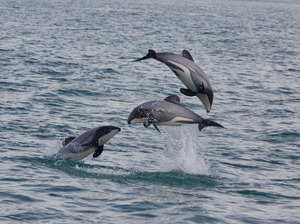
Group Dynamics
Hector's dolphins live in small, flexible social groups. The average group size is between two and eight dolphins. These social structures are known as "fission-fusion" groups, meaning dolphins regularly join and leave different groups throughout the day without forming rigid, permanent packs.
Scientists have observed three main types of groupings:
- Nursery Groups: Small gatherings of mothers with their young calves, keeping away from adult males to protect the young.
- Juvenile Groups: Young, playful dolphins that travel together, practicing social behaviours and hunting techniques.
- Mixed Adult Groups: Associations of mature males and females that come together to forage, travel, and socialise.
Occasionally, when large schools of small fish enter shallow bays, several small groups will merge into larger aggregations of 20 to 50 dolphins to hunt together.
Surfacing and Play Behaviour
Hector's dolphins are active and playful animals. They can often be seen performing acrobatic aerial displays in coastal surf zones. Common behaviours include:
- Breaching: Leaping completely clear of the water and splashing down on their sides or backs.
- Tail Slapping (Lobtailing): Slapping their tail flukes against the ocean surface to create loud slapping noises.
- Bow Riding: Surfing the pressure waves created by the bows of boats or swimming in natural ocean swells and breaking waves.
- Spyhopping: Poking their heads straight up out of the water to inspect their surroundings above the surface.
Echolocation and Communication
Like all toothed cetaceans, Hector's dolphins use echolocation (biological sonar) to navigate murky waters and hunt for food. They produce short, high-frequency ultrasonic clicks from a specialised fatty organ in their forehead called the melon.
These clicks bounce off underwater objects, fish, and the seabed. The returning echoes are received through the lower jaw and transmitted to the inner ear, allowing the dolphin to build a precise 3D mental map of its environment.
Hector's dolphin clicks are narrow-band and high-frequency, oscillating around 115 to 135 kilohertz. These frequencies are well above the upper limit of human hearing, which stops around 20 kilohertz. These high frequencies allow them to detect very small prey items in turbid water while remaining undetected by large predators like orcas, which listen for lower-frequency whistles.
Diet and Hunting Methods
Hector's dolphins are opportunistic, generalist predators. They feed on a wide variety of small marine organisms found throughout the water column, ranging from surface-schooling fish to species that live on the muddy seafloor.
Primary Prey Items
Studies examining stomach contents have shown that Hector's dolphins prefer small fish and cephalopods, usually under 15 centimetres in length. Their diet includes:
- Red cod (Pseudophycis bachus)
- Ahuru (Auchenoceros punctatus)
- Flatfish and soles
- New Zealand sprat
- Arrow squid
- Juvenile giant stargazer (Kathetostoma giganteum)
- Crabs and small crustaceans
Foraging Strategies
Hector's dolphins use versatile hunting techniques to catch prey in different marine habitats. They hunt in small teams to encircle schools of small fish in shallow bays, herding them towards the surface or into shallow sandbanks where they cannot escape.
They also forage along the seafloor, using focused echolocation pulses to detect flatfish and crabs buried beneath the sand or silt. Because their prey items are small, Hector's dolphins swallow their food whole and do not need to tear it apart.
Reproduction and Life Cycle

Life Span and Maturity
Hector's dolphins have a relatively short life span compared to larger whale and dolphin species. Photo-identification studies tracking dolphins over decades show that they typically live between 15 and 20 years in the wild, with a few individuals documented reaching up to 22 years of age.
They mature late in life:
- Males reach maturity between 6 and 9 years of age.
- Females begin producing their first calves between 7 and 9 years of age.
Calving and Maternal Care
Breeding and calving take place during the warm spring and summer months (between November and February). A female carries her calf for a gestation period of roughly 10 to 11 months.
A mother gives birth to a single calf tail-first near the ocean surface. She immediately helps the newborn rise to the surface to take its first breath of air. Mothers provide extensive maternal care:
- Calves nurse on nutrient-rich milk produced by the mother for about 12 months.
- Young dolphins stay close to their mother's side for one to two years, learning navigation routes and foraging skills.
- Females produce a new calf only once every two to three years.
Because females mature slowly, live relatively short lives, and produce only one calf every few years, a healthy female may only raise four to seven calves in her entire lifetime. Consequently, the species has an extremely slow natural population growth rate of roughly 2% to 4% per year, making it difficult for populations to recover quickly from human-caused losses.
Predators and Natural Hazards
Hector's dolphins have several natural predators in New Zealand waters. Their small size makes them vulnerable to large coastal carnivores:
- Sharks: Broadnose sevengill sharks (Notorynchus cepedianus) are considered their primary natural predator. Remains of Hector's dolphins have also been discovered in the stomachs of great white sharks (Carcharodon carcharias) and blue sharks (Prionace glauca).
- Orcas: The orca (Orcinus orca), or killer whale, is an apex predator known to hunt smaller dolphins and marine mammals along the New Zealand coastline.
To protect themselves from predators, Hector's dolphins stay in shallow coastal waters that large sharks and orcas find difficult to navigate. They also maintain vigilant social groups that keep watch while feeding.
Threats and Conservation Challenges
Hector's dolphins face multiple human-caused threats that have led to significant historical population declines.
Fishing and Bycatch
The greatest historical threat to Hector's and Māui dolphins has been accidental capture in commercial and recreational fishing gear, known as bycatch:
- Gillnets (Setnets): These fine, lightweight nylon nets hang vertically in the water column to catch fish. Because the fine monofilament mesh is hard to detect with dolphin echolocation, dolphins can become entangled. Because they are air-breathing mammals, trapped dolphins drown if they cannot reach the surface.
- Trawl Nets: Large funnel-shaped nets pulled through the water by fishing boats can also accidentally trap Hector's dolphins that are attracted to feed on fish stirred up around the nets.
Throughout the late twentieth century, thousands of Hector's dolphins were accidentally caught in coastal setnets, causing population numbers to drop significantly.
Infectious Diseases
Disease is another major threat affecting both subspecies:
- Toxoplasmosis: This serious disease is caused by the microscopic parasite Toxoplasma gondii. Domestic and feral cats are the only animals that shed this parasite's eggs into the environment. Rain washes these microscopic eggs down rivers and storm drains into coastal waters, where they are consumed by shellfish and small fish. When Hector's dolphins eat these marine animals, the parasite infects their lungs, liver, and brain. Toxoplasmosis is one of the leading non-fishing causes of death for both Hector's and Māui dolphins.
- Brucellosis: A bacterial infection caused by Brucella species that can cause organ damage and reproductive failure in marine mammals.
Habitat Disruption and Pollution
Because Hector's dolphins live close to human settlements, their habitat is exposed to various coastal activities:
- Noise Pollution: Underwater noise from boat engines, port construction, dredging, and seismic surveys can interfere with their sensitive echolocation, making it hard for them to hunt, communicate, and navigate.
- Chemical Contaminants: Runoff from agriculture, industrial sites, and urban areas washes heavy metals, plastic debris, and toxic chemicals into coastal bays.
- Sedimentation: Land clearing and coastal development increase the amount of soil washing into rivers, which can smother seafloor feeding areas.
Conservation Measures and Marine Protection
To halt the decline of Hector's and Māui dolphins, the New Zealand government and conservation groups have created several protected zones and regulations.
Marine Protected Areas and Sanctuaries
New Zealand has established multiple Marine Mammal Sanctuaries and fisheries closures to protect key dolphin habitats:
- Banks Peninsula Marine Mammal Sanctuary: Created in 1988 as the first sanctuary for Hector's dolphins, this reserve was expanded in 2020 to cover over 14,000 square kilometres. It extends 20 nautical miles offshore and restricts commercial gillnetting, seabed mining, and seismic acoustic testing.
- West Coast North Island Sanctuary: Established in 2003 to safeguard the remaining Māui dolphins, restricting setnetting across large areas of their core coastal territory.
- Regional Closures: Setnet bans and trawling restrictions now cover large sections of the South Island's east, south, and west coasts.
Modern Technology and Research
Scientists use modern technology to track and study Hector's dolphins without disturbing them:
- Drone Surveys: Uncrewed aerial vehicles capture high-definition photographs of dolphin pods to measure calf numbers and assess body condition.
- Acoustic Listening Devices: Hydrophones anchored to the seabed record dolphin echolocation clicks 24 hours a day, helping researchers map where dolphins feed at night.
- Genetic Sampling: Small skin samples collected with specialised darts provide DNA that allows scientists to track family lineages, genetic diversity, and monitor population health.
Through ongoing habitat protection, improved fishing gear rules, and public education campaigns, conservationists aim to ensure that Hector's dolphins and Māui dolphins thrive in New Zealand's waters for generations to come.
See Also
 In Spanish: Delfín de Héctor para niños
- Endangered species
- List of cetaceans
- Mammals of New Zealand
- Marine biology
- Ocean conservation
